
Located in Mingjian Township, Nantou County, the Songbailing tea region sits at the southernmost end of the Bagua Mountain Range at an elevation of 200 to 400 meters. Although not very high, the environment is ideal for growing tea, allowing the tea industry to develop here early on. The resulting Songbailing Oolong is of excellent quality, making it a benchmark tea region for mid-to-low elevations. Songbailing tea was formerly known as “Puzhong tea” or “Songbaikeng tea.”
During his tenure as Premier, President Chiang Ching-kuo inspected the area and named it “Songbai Evergreen Tea,” which gradually boosted the region’s renown. Later, the introduction of mechanical harvesting reduced production costs, making Songbailing tea synonymous with economical and accessible tea.
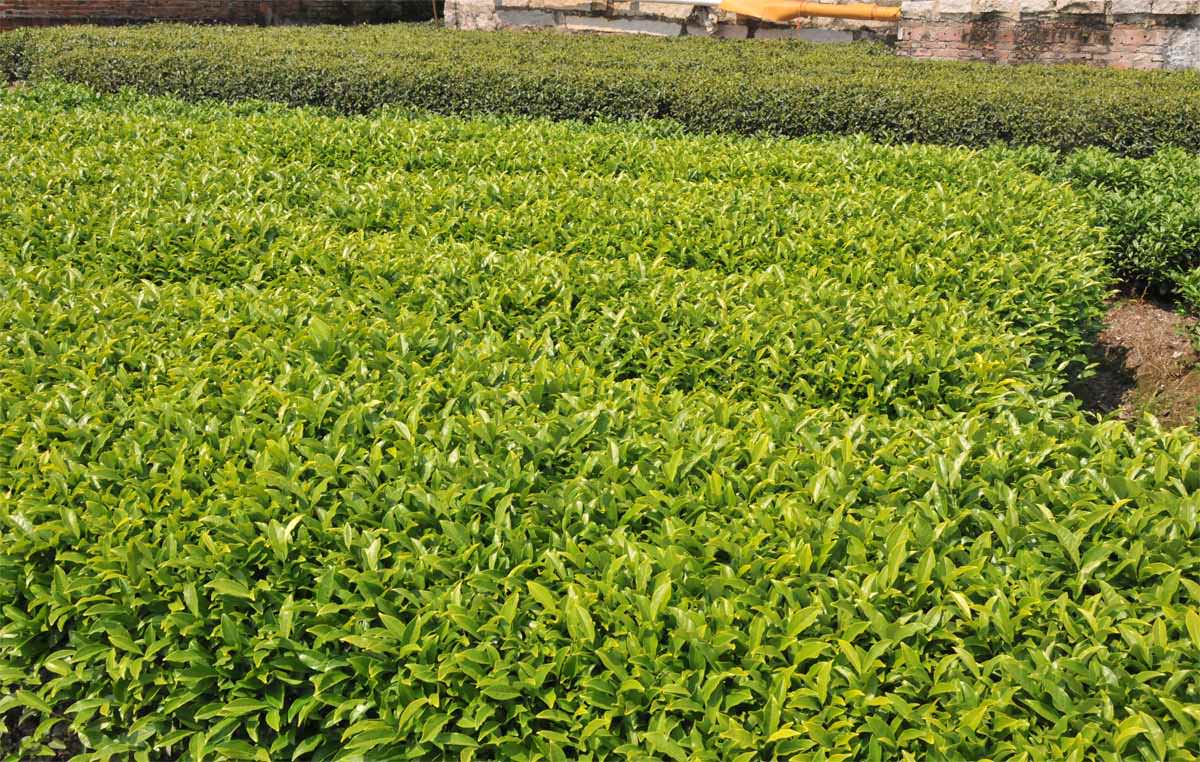
Today, the Songbailing tea region produces varieties such as JinXuan, Qingxin Oolong, CuiYu, and Sijichun. To meet the demands of mechanical harvesting, the majority of production focuses on JinXuan, CuiYu, and Sijichun, which feature wider bushes and higher yields. Harvested 5 to 6 times a year, it supplies the Taiwan tea market with consistently high-quality, affordably priced mid-to-low-elevation Oolong tea.
Directions: Take the Mingjian Interchange on Formosa Freeway (National Highway No. 3) and turn onto County Route 150 to arrive. From the Wangtian Interchange on Sun Yat-sen Freeway (National Highway No. 1), take the Dadu Bridge, Provincial Highway 14, Fenyuan, and Nantou County Route 150 to reach Songbailing. For public transportation, get off at Tianzhong Station and take the Changhua Bus to Songbailing.