
Ruicaokui is produced in Yashan, Anhui, China. Also known as Yashan Tea, it belongs to the green tea category. As a historically renowned tea, Ruicaokui has enjoyed enduring fame since its creation in the Tang dynasty and remains popular today, beloved not only in the Chinese market but also in Europe and America.
Mt. Yashan is home to the ancient Yashan Temple and the ruins of Yashan Street, as well as the birthplace of Yashan Tea. Lu Yu’s Classic of Tea from the Tang dynasty records: “Ruicaokui is produced in Mt. Yashan in southern Anhui, also known as Yashan Tea.” Wang Xiangjin’s Classified Materia of Flowers from the Ming dynasty states: “Yashan sunny slope cross-grain tea, also known as Ruicaokui,” proving its long history.
Ruicaokui is characterized by straight, flat leaves shaped like sparrow tongues, an emerald green color, prominent downy hairs (pekoe), a high and lingering aroma, a long-lasting fresh fragrance, a yellowish-green liquor, a clear and bright appearance, and a fresh, smooth, and brisk taste. Among them, spring tea harvested between Qingming and Guyu is of the highest quality.
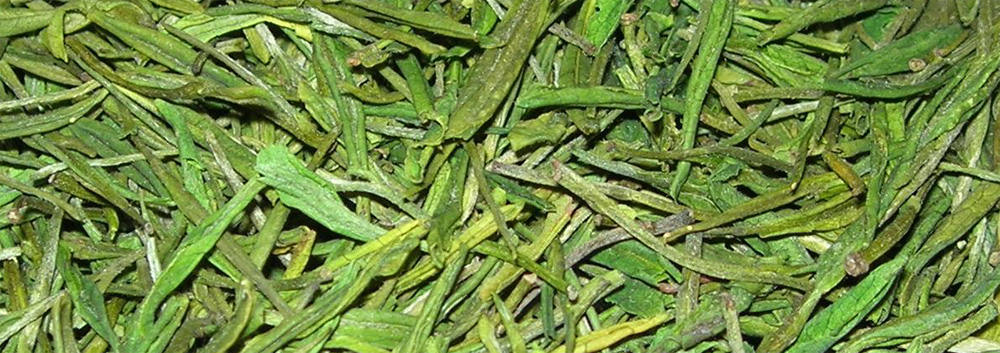
Production Method of Ruicaokui
Harvested between Qingming and Guyu, ideally with one bud and one leaf. Rain-damaged leaves, diseased leaves, old leaves, and purple leaves are not picked. After harvesting, the leaves are spread out to wither for 4 hours before processing begins.
The craftsmanship consists of three main steps: fixating (kill-green), shaping, and drying. A special part of this process is shaping: the wok temperature is maintained at 70°C, and the leaves are rubbed by hand during pan-firing. As the moisture content of the tea gradually decreases, the tea leaves naturally become straight and flat. They are removed from the wok when the moisture content reaches 25%.
Drying is divided into the first and second drying phases. The first drying involves 4 drying baskets set at 90°C, 80°C, 70°C, and 60°C respectively, with each basket dried for 4 minutes in sequence. Once completed, the second drying begins. The second drying uses a gentle, low-temperature fire at around 60°C until the moisture content drops to 5%.
Using traditional methods, the finest Ruicaokui should feature a straight, slightly flat appearance with visible downy hairs, a distinct aroma, and a yellowish-green liquor. Achieving this level of quality typically commands a price of over 1,000 RMB per 500 g.
Brewing Guide
Let mountain spring water rest overnight, boil it, and then let it sit for 5 minutes until the temperature drops to 85°C before brewing. Transparent tea vessels are preferred, and do not cover them with a lid so you can observe the shape and color of Ruicaokui. It can be steeped 3 times: the first infusion for 2 minutes, with each subsequent infusion increasing by 1 minute.