
A few days ago, an overseas customer asked if we could help source “Dayuling 105K” tea for them. We explained that the 105K tea garden was completely removed back in 2015. However, the customer was still skeptical because there are many online sellers claiming to offer 105K with very vivid descriptions. We put together this article to shed light on tea gardens that have either vanished or never existed at all, helping fellow tea lovers avoid buying fake tea from unknown sources.
Vanished Tea Gardens
Most of these high-mountain teas are produced along the Central Cross-Island Highway, with the hotspot located between 90K and 105K, covering Biluxi, Dayuling, and Tianfu Farm. Many tea gardens here were cultivated on public land involving illegal use and squatting issues. Consequently, the Taiwanese government conducted a large-scale crackdown between 2014 and 2015 to clear these illegal plantations.
Tea Gardens That Never Existed or Shouldn't Be on the Market
In addition to vanished tea gardens, there are some that actually never existed in the first place, or belong to areas whose tea should not be available in general tea shops. For example, as mentioned before with “Dayuling Water Source“, as well as 93K, 108K, and 109K—these locations belong to “tea gardens that never existed.” If you see sellers offering tea from these places, it is almost certainly a marketing fiction.
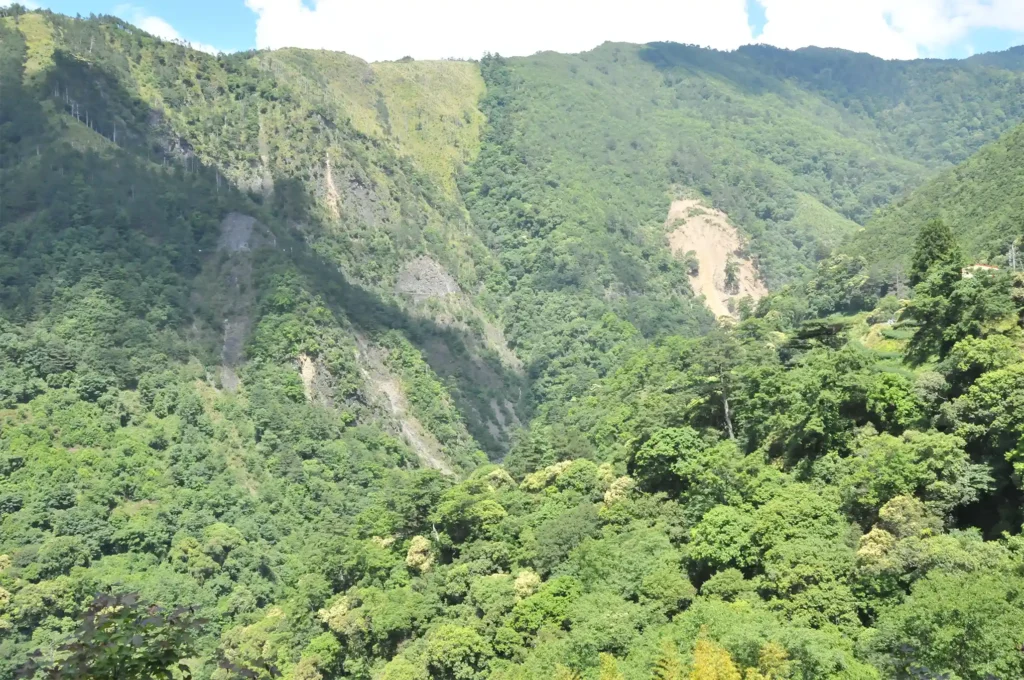
The image above shows the Central Cross-Island Highway at 90–93 km in 2013. There was a tea garden to the top right of the landslide area, which was abandoned after the landslide.
Additionally, while location names like “Fushoushan Daguan Pavilion” and “Fushoushan Heavenly Pool” can be found on maps—and there is indeed a tea garden nearby—these teas are not meant for general commercial distribution. This is because the tea garden belongs directly to Fushoushan Farm. Unless directly distributed by the official farm, it is impossible for these teas to be sold in ordinary tea shops. Therefore, tea labeled with these locations is very likely fake as well.
Why Fake Tea Is Rampant in the Market
Why do so many tea merchants continue to market teas from tea gardens that no longer exist or never existed at all? The reason is simple: high-mountain tea fetches high prices and offers substantial profit margins. Teas from regions like Lishan, Dayuling, and Biluxi are highly sought after for their high elevation and superior quality, with prices often exceeding NT$10,000 per 600 g. Consequently, many vendors package their products under the names of these non-existent or defunct tea gardens to maximize their profits.
For consumers, the biggest risk isn’t just wasting money—it’s potentially consuming tea from untraceable sources with unmonitored pesticide residues, posing potential health risks.
How Can Consumers Tell the Difference?
With fake teas flooding the market, consumers need to stay vigilant. When buying tea, always verify the origin of the tea garden. Watch out for notoriously fake location labels such as 105K, 108K, Dayuling Water Source, or Fushoushan Tianchi—these should be treated as immediate red flags. Additionally, be cautious of prices that are too low: if tea labeled from Lishan or Dayuling is priced suspiciously low (such as a few hundred or under NT$1,000–NT$2,000 per 600 g), it is very likely a counterfeit.