
Aside from Niulan Rougui and Matouyan Rougui, another tremendously popular Yancha (cliff tea) terroir in recent years is “Xintourou” Tianxinyan Rougui. Tianxinyan is the terroir name, and Rougui is the tea tree cultivar. Combined, they form Tianxinyan Rougui Tea, affectionately abbreviated as Xintourou.
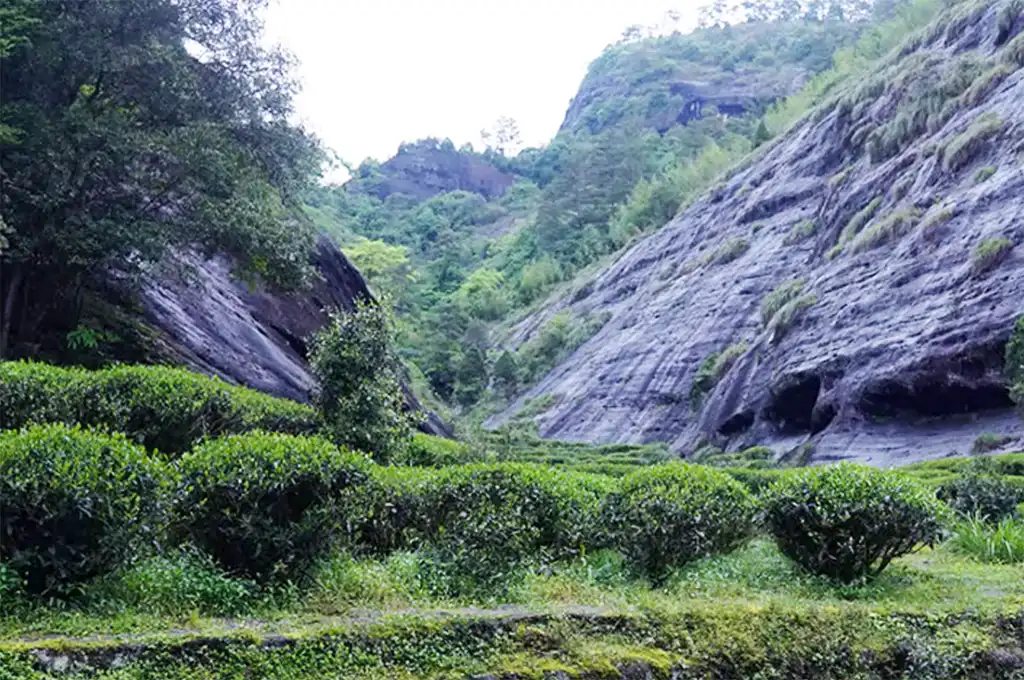
"Xintourou" Tianxinyan Rougui Tea: Premium Zhengyan Rougui Wuyiyan Tea
Wuyi’s terroirs are best known for the “Three Pits and Two Streams” (Niulan Keng, Huiyuan Keng, Dakengkou, Wuyuan Jian, and Liuxiang Jian). Situated near rocky mountains with subsoils rich in conglomerate, gravelly sandstone, and sandy shale—echoing Lu Yu’s Classic of Tea: “The finest grow in weathered rocks, moderate ones in gravelly soil, and the inferior in yellow earth”—these are considered the premier terroirs for producing cliff teas.
A few premium tea gardens are known as “Zhengyan” (true rock) origins. Due to varying terrain and environments, different mountain sites produce distinct characteristics. For instance, the Rougui from Matouyan exhibits a high-aroma profile, while Niulankeng typically delivers an elegant and delicate character. In recent years, Tianxinyan Rougui tea has also become a sought-after tea region under these conditions, with “Xintourou” emerging as one of the most popular Wuyi Rock Tea items following Niurou and Marou.
What is Rougui?
Wuyi Rock Tea products are mainly categorized into Da Hong Pao, Rougui, Shuixian, Mingcong, Qizhong, and others. Rougui is the name of the tea tree variety. Well-suited for making oolong tea, Rougui boasts exceptional quality and a pronounced varietal character. Its aroma is pungent, sharp, and lingering, featuring notes of cinnamon, milk, or flowers and fruit, with a rich, bold, and piercing taste. Among the major Wuyi tea tree varieties, there is a saying: “No aroma surpasses Rougui, no mellowness surpasses Shuixian.” In recent years, it has become one of the top three most planted varieties locally.
Through years of craftsmanship research by Wuyi tea makers, the production techniques for Rougui have become increasingly refined, capable of bringing out its rich aromatic profiles—resembling osmanthus, gardenia, orchid, peach, cinnamon, and乳香 (milky/frankincense) notes.
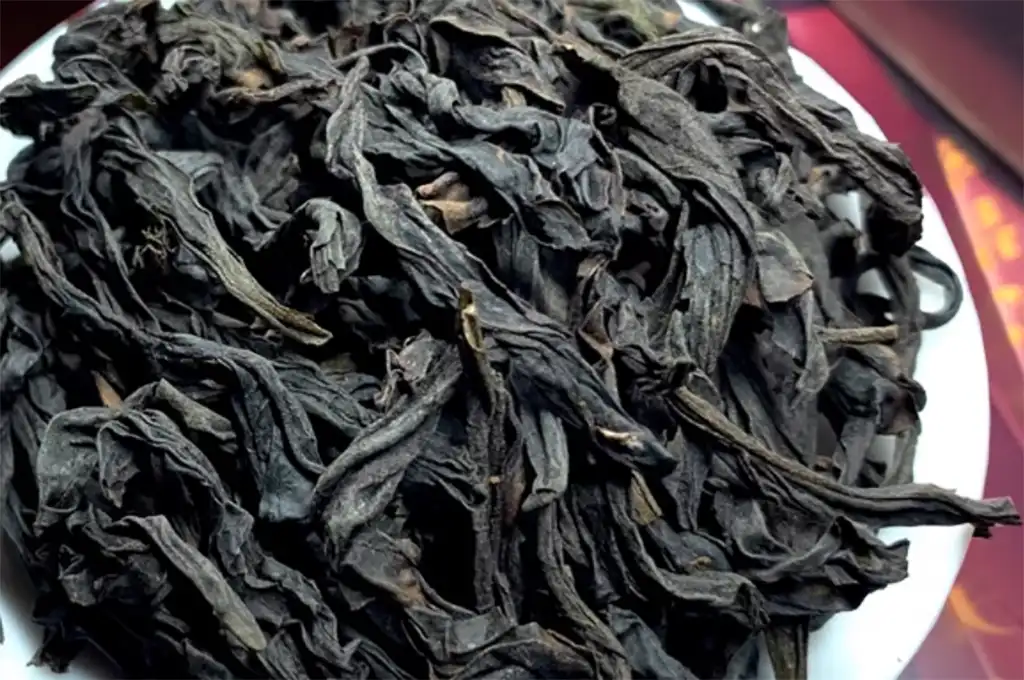
Tianxinyan Belongs to the Zhengyan Origin
Located in the northeastern part of Wuyi Mountain, Tianxinyan belongs to the Zhengyan (true rock) tea region. According to the “Chronicles of Wuyi Mountain” written by Dong Tiangong in the Qing dynasty: “Measured across the entire hundred-and-twenty-li mountain, this peak lies at its very center, much like the pivot of the heavens, hence it is called Tianxinyan (Heaven’s Heart Rock).” Famous scenic spots and tea regions in the northern Wuyi Mountains—such as Liuxiangjian, Yuzhufeng, Huiyuansi, Yingzuiyan, Shuiliandong, Duhaiyan, Matouyan, and Qingshiyan—all surround Tianxinyan. Consequently, Tianxinyan is also considered the central tea-producing region of Wuyi Rock Tea.
What are the Characteristics of Tianxinyan's Origin and Its Rougui Tea?
Wuyi Mountain‘s unique Danxia landform endows Wuyi Rock Tea with its exceptional quality. Tianxinyan is situated in the core Zhengyan tea region, surrounded by mountains and lined with steep cliffs. Its soil contains a higher amount of gravel, featuring a thick, loose layer with good aeration that facilitates drainage. With steep gorge cliffs, short summer sunlight, blocked winter cold winds, and fine trickling water streams at the valley floor, Tianxinyan Rougui tea trees grow on these unique sandstone pebbles, absorbing a rigid, resilient character from the rocks. Transferred into the tea liquor of Xintourou, this results in a heavy, smooth tea with a pure, deep, and distant aroma.
Read More:
- How to Brew Wuyi Rougui Tea: What Are the Key Tips?
- Is Shuixian Tea Green Tea? What Kind of Tea Is Shuixian?
- What Are the Differences Between Shuixian, Rougui, and Da Hong Pao in Wuyi Rock Tea?
- What Type of Tea Is Da Hong Pao? Is It Black Tea, Green Tea, or Oolong Tea?
- Where to Buy Da Hong Pao Tea? Is Da Hong Pao Produced in Taiwan?
- Which Tea Category Does Wuyi Rock Tea Belong To? Is It Pu-erh Tea?