
Jinshan Cuiya originates from Zhenjiang City, Jiangsu Province, and belongs to the green tea category. Created in the 1980s, while not a centuries-old historical tea, Jinshan Cuiya has gained popularity across China in recent years due to its exceptional quality, leading to expanding cultivation areas. Because it is difficult to produce, Jinshan Cuiya is relatively expensive.
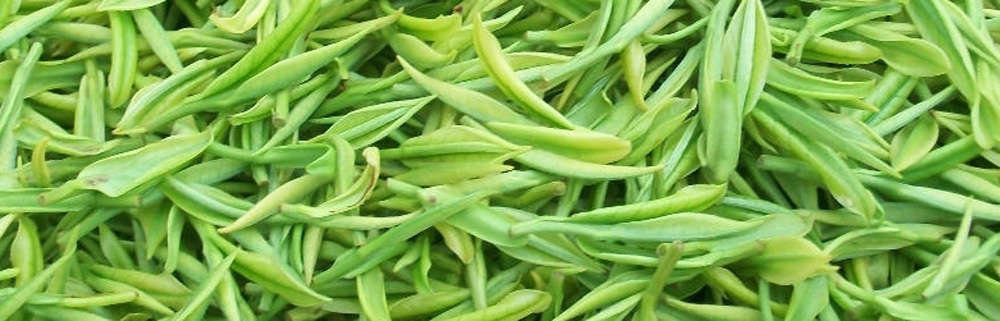
Jinshan Cuiya is made exclusively from premium Dahao and Dabai tea buds. Harvesting is challenging, and the production process is exceptionally meticulous, making it difficult to manufacture. It is characterized by its wonderful color and aroma, with a sweet aftertaste. When brewed, the tea buds either suspend near the water’s surface or stand upright at the bottom of the cup, resembling vibrant green bamboo shoots in spring—offering a remarkable visual experience. This is one of the most distinctive features of Jinshan Cuiya.
Production Craft
The spring tea is harvested around Guyu (Grain Rain). The harvesting standard is one bud with one leaf, with buds and leaves measuring about 3 mm. The leaves must not be damaged, and after harvesting, they must be air-dried for 3 hours before pan-firing.
The process is divided into three stages: initial pan-firing, air-cooling, and secondary pan-firing. The initial pan-firing temperature is 120°C, focusing on tossing first followed by smothering, lasting about 3 minutes. After the initial pan-firing, shaping is performed to flatten the tea leaves. This is followed by 20 minutes of air-cooling.
The secondary pan-firing temperature is 75°C, during which the flattening process continues. As the moisture content drops to 6%, the tea leaves should take on a beautiful flat shape, at which point they can be removed from the wok and packaged.
Under traditional methods, top-grade Jinshan Cuiya should be flat, even, and uniform, suspending or standing at the bottom of the cup when brewed.
Brewing Jinshan Cuiya
Jinshan Cuiya can be brewed flexibly, though mountain spring water remains the best choice. Various tea ware can be used, but transparent teaware is highly recommended so you can watch the leaves float or stand upright.